Showing posts with label Technology. Show all posts

VoIP - Revolution in Telephony??

Sunday, 6 April 2014


 VoIP is Voice over Internet Protocol, which is a method of making your voice transmit over Internet. We are familiar with Skype and Google talk where we make free phone calls. VoIP can make standard internet connection turn into a free phone booth. VoIP is a revolutionary technology that has the potential to completely rework the world's phone systems. 

VoIP use Analog Telephone Adapter (ATA), IP Phones and Normal Computer for making calls. VoIP phone users can make calls from anywhere there's a internet connection. 

Your voice is sent in terms of Packets to destination via internet. VoIP technology uses the Internet's packet-switching capabilities to provide phone service. VoIP has several advantages over circuit switching. For example, packet switching allows several telephone calls to occupy the amount of space occupied by only one in a circuit-switched network. 


Read more ...

BluRay What Next?

Sunday, 23 March 2014

Holographic Versatile Disc (HVD

HVD Logo shaded.png
Holographic versatile disc (HVD) is a holographic storage format that looks like a DVD but is capable of storing far more data. Prototype HVD devices have been created with a capacity of 3.9 terabytes (TB) and a transfer rate of 1 gigabit per second (1 Gbps). At that capacity, an HVD could store as much information as 830 DVDs or 160 Blu-Ray discs. 


Holographic Memory


Holography is a method of recording patterns of light to produce a three-dimensional object. The recorded patterns of light are called a hologram.

Most of us think of holograms as storing the image of an object, like the Death Star pictured beside. The holographic memory systems we're discussing here use holograms to store digital instead of analog information, but it's the same concept. Instead of the information beam encountering a pattern of light that represents the Death Star, it encounters a pattern of light and dark areas that represent ones and zeroes.


Read more ...

Organic light!

Wednesday, 19 March 2014

Organic LEDs


Imagine having a HD TV that is 80 inches wide and less than a quarter-inch thick and can be rolled up when you're not using it. What if you could have a display in your car? How about a display monitor built into your clothing? These devices may be possible in the near future with the help of a technology called organic light-emitting diodes (OLEDs).

 OLEDs are solid-state devices composed of thin films of organic molecules that create light with the application of electricity.


Structure of OLEDs

Like an LED, an OLED is a solid-state semiconductor device. They have either two layers or three layers of organic material; in the latter design, the third layer helps transport electrons from the cathode to the emissive layer.

By flow of electrons from cathode to anode, and holes the other way due to emissive and conductive organic layer the charges recombine to produce light. Emissive layer is responsible for light emission.


Foldable OLED

Foldable OLEDs have substrates made of very flexible metallic foils or plastics. Foldable OLEDs are very lightweight and durable. Their use in devices such as cell phones and PDAs can reduce breakage, a major cause for return or repair. Potentially, foldable OLED displays can be attached to fabrics to create "smart" clothing, such as outdoor survival clothing with an integrated computer chip, cell phone, GPS receiver and OLED display sewn into it.

Some more facts of OLEDs


  • OLEDs have large fields of view, about 170 degrees. Because LCDs work by blocking light, they have an inherent viewing obstacle from certain angles. OLEDs produce their own light, so they have a much wider viewing range.
  • Lifetime - While red and green OLED films have longer lifetimes (46,000 to 230,000 hours), blue organics currently have much shorter lifetimes (up to around 14,000 hours[source: OLED-Info.com]).
  • Both Samsung and LG began flexible OLED mass production. Samsung is making a 5.7" Full-HD panels while LG is making 6" 720p ones.
  • The Galaxy Round is the world's first device with a flexible OLED - it has a 5.7" Full-HD curved display, based on a plastic substrate
  • LG Electronics introduced their 2014 TV lineup in Korea - unveiling a total of 68 new models. The company will launch 77", 65" and 55" OLED TVs - some of which will feature 4K UHD resolution. The company did not yet announce prices and availability, but they did say that they will start releasing the new TVs in key markets later this month.
  • Faster refresh rate, better contrast and better color reproduction.

 
Read more ...

PCB Design TOOL!!! by DesignSpark PCB

Tuesday, 18 March 2014
title 


DesignSpark PCB is the world’s most accessible electronics design software. Easy to easy to learn and easy to use, DesignSpark PCB is designed to significantly reduce your concept-to-production time. At the core of this unique approach is a powerful software engine that enables you to capture Schematics, design PCB boards and layouts. DesignSpark PCB had won multiple awards and with over 250,000 registered users it emerges as an electronic industry's standard for collaboration and file sharing!


title

 World’s first truly FREE and unrestricted electronics design software. Developed by RS Components/Allied Electronics to enable engineers rapidly design great products, DesignSpark PCB had won multiple awards since 2010 while attracting over 250,000 activations. This breakthrough in accessibility, backed by powerful features enabled engineers to share designs within teams and externally - bringing collaborative hardware design to a whole new level.

http://www.designspark.com/eng/knowledge-item/designspark-pcb-product-brochure 

Download LINK:
 http://pcb.designspark.info/DesignSparkPCB_v6.exe


Want to know more? See a high level overview of the core functionality of DesignSpark PCB:


Read more ...

Soft Core Processors

Friday, 14 March 2014
Due to growth in use of FPGA and ASIC, the design of specific hardware units reduced. Application specific processors which are not needed for other applications are designed on these Configurable ICs.


As logic in these ICs are implemented using HDL synthesis. The implementation of a specific microprocessor is carried out in way, where a specific hardware of the mu-p is not developed rather it is built on an available configurable logic platform.


Soft-core processors are microprocessors whose architecture and behaviour are fully described using hardware description language (HDL).


Some common soft core processors used are: Nios II by Altera, MicroBlaze from Xilinx, LEON by Gaisler Research, OpenRISC 1200.

Read more ...

Google GLASS

Saturday, 1 March 2014
Every one wants to have their hands free when it comes to having a mobile. And if u have a computer which is portable like your spectacles and does whatever you want. Life is lot easier.

 
It is first entry to wearable tech market.

Say "take a Picture" and have one.


Google glass is a wearable computer with an optical head-mounted display (OHMD), displaying information in smartphone like hands free format. And you can communicate with it in your own language.

How it Works?

 For anything to be interactive, it has to communicate. How it does?
3Ways: Display, Touch pad, Camera.

Display

How can glass display like smartphone? - It uses Liquid Crystal on Silicon (LCoS), with Polarizing Beam Splitter (PBS). 

TouchPad

A touchpad is located on the side of Google Glass, allowing users to control the device by swiping through a timeline-like interface displayed on the screen.

 Camera

Take photos at 5MP and videos at 720p.


Technology it uses!!!

For a Device like this. It needs whole lot of technlogoy!!
No its not that way, it needs few smart TECHs.
It is made of:
  1. Augmented Reality - Feel environment around you interactive.
  2. Wearable Computers - People give attractive names, its a computer which requires low power and can come in contact with body! SO THERE IS CONTINUOUS INTERACTION BETWEEN USER AND COMPUTER!!!
  3.  Optical Head Mounted Display

What are its specifications!!!


For the developer Explorer units:
  • Android
  • 640×360 Himax helloHX7309 LCoS display
  • 5-megapixel camera, capable of 720p video recording
  • Wi-Fi 802.11b/g
  • Bluetooth
  • 16GB storage (12 GB available)
  • Texas Instruments OMAP 4430 SoC 1.2Ghz Dual(ARMv7)
  • 682MB RAM
  • 3 axis gyroscope
  • 3 axis accelerometer
  • 3 axis magnetometer (compass)
  • Ambient light sensing and proximity sensor
  • Bone conduction audio transducer


FINALLY HOW MUCH IT COSTS: $1,500


Read more ...

OMAP (Open Multimedia Aplication Platform)

Monday, 24 February 2014
 
   OMAP is a series of image and video processors developed by Texas Instruments. It is a IC with ARM Processor and a DSP Co- Processor.

The OMAP family consists of three product groups classified by performance and intended application:
  • High-performance applications processors
  • Basic multimedia applications processors
  • Integrated modem and applications processors
 OMAP Series are of these types:
  1. OMAP 1
  2. OMAP 2
  3. OMAP 3
  4. OMAP 4
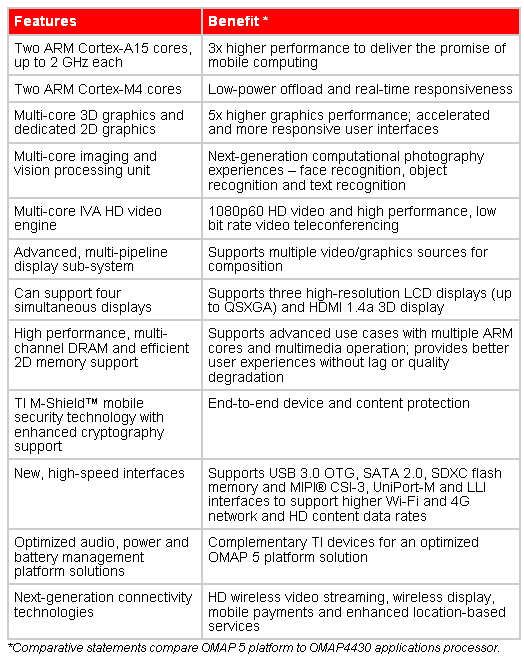
  5. OMAP 5

OMAP processors contain unique hardware and software elements to support best-in-class video, graphics and multimedia performance.
OMAP processors natively support more video playback codec standards than other processors, meaning OMAP processors come ready to efficiently play nearly any video from anywhere in the world with little to no additional development investment. Video capture and playback are both accelerated by the platform’s IVA-HD hardware engine, freeing up the main ARM® Cortex™-A series MPCores for other processing tasks.


Other unique video features include:
  • Simultaneous video and still image capture enabled by a high performance image signal processor.
  • Super compressed video files that take up 10 – 20 percent less memory storage space compared to competing processors, enabled by proprietary TI imaging technology.
  • Snappy and responsive rendering of cloud-based or remote desktop applications, made possible by the OMAP platform’s combination of hardware and software accelerators and graphics core.

-----------------------------------------------------------------------------------------------------

Read more ...

Touch Screen

Tuesday, 18 February 2014

Touch screen! 

Its one of the most amazing technology developed which we are attracted with. The first mobile with touchscreen i.e., IBM Simon,was launched in 1992. 


How does it work?

Variety of technologies are present to detect your finger on the screen. They are some kind of sensors usually capacitive or resistive which detect it. Recent advancements are on inductive technology which is acquiring its prominence. 

Resistive Touch

It has some layers for functionality. But two layers which are facing each other, one beneath the screen and on the substrate with a thin gap between, makes the heart of tech. One is excited by voltage and other senses it. So your finger pressure connects them at that point for sensing.
It is advantageous because of its low price, but at the cost of needing to press down a bit more.


Capacitive Touch  

The lower layer of screen is coated with some conducting transparent material such as Indium Tin Oxide(ITO), and insulator screen acts as Di-electric. Known that your finger conducts. So the touch changes the capacitance, which senses the finger.
There are more variations of this, but the change in capacitance plays a major role.


Inductive Touch

Here a layer coated below the screen and PCB trace coils beneath create magnetic field. upon touch the the field strength varies which is measurable, this provides the required sensing mechanism.
Read more ...

ElectroWeb embedded views

Contact Form

Name

Email *

Message *

Google+